🇮🇳 Driving in India
Rules of the road
The law: Motor Vehicles Act
Driving in India is governed by the Motor Vehicles Act, 1988, which was heavily amended in 2019 with much higher fines, and by the Rules of the Road Regulations. Traffic police in each state and city enforce them, and states can add their own rules, such as local speed limits and no-honking zones.
Keep left, overtake on the right
Drive on the left side of the road and overtake on the right. Overtaking on the left is not allowed. The exception is when the vehicle ahead has signalled that it is turning right and moved over to do so. Don't overtake near bends, junctions, pedestrian crossings or on a hill where you can't see ahead.
Speed limits
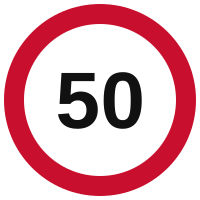
Speeds are in km/h. A 2018 central government notification sets upper limits for cars of up to 120 km/h on expressways, 100 km/h on four-lane national highways, and 70 km/h on city roads. States and cities usually post lower limits, often 40–60 km/h in towns, so the number on the sign is the one that counts. Speed cameras are common on expressways.
Helmets and seat belts
- Two-wheelers: both the rider and the pillion passenger must wear a helmet that meets the BIS (ISI-marked) standard, fastened properly. Children aged 9 months to 4 years need a crash helmet and a safety harness, and the bike must go no faster than 40 km/h with them on board.
- Cars: everyone must wear a seat belt, including passengers in the back seat.
Junctions and roundabouts
At an uncontrolled junction, give way to vehicles on a main road. If neither road is a main road, give way to traffic approaching from your right. At roundabouts, traffic goes clockwise, and you give way to vehicles already on the roundabout, which come from your right.
Emergency vehicles
You must give way to ambulances and fire engines. Since 2019, failing to make way for an emergency vehicle can bring a fine of up to ₹10,000.
Horns
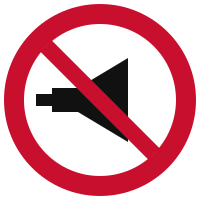
Use the horn only when needed to warn others. It is not allowed in signed no-honking zones, which are common near hospitals, schools and courts. Loud pressure horns and multi-tone horns are illegal.
Alcohol and phones
- Drink driving: the limit is 30 mg of alcohol per 100 ml of blood. A first offence can mean a fine of up to ₹10,000, up to 6 months in jail, or both.
- Phones: making calls or texting on a hand-held phone while driving is an offence. Using a phone for navigation is allowed, as long as it doesn't distract you.
Documents to carry
Carry your driving licence, the vehicle's registration certificate (RC), valid insurance (third-party cover is the legal minimum) and a PUC (pollution under control) certificate. Digital copies in the official DigiLocker or mParivahan apps are accepted.
Getting a licence
First you get a learner's licence, which needs a short test on road rules and signs and is valid for 6 months. After at least 30 days, you can take the driving test for a permanent licence. You can apply online through the Parivahan Sewa portal.
Common road signs
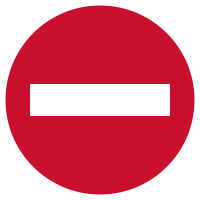
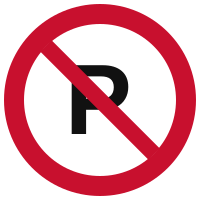
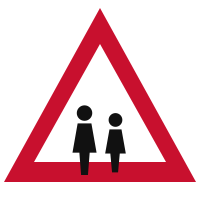
Indian signs come in three groups: mandatory signs (red circles say what's not allowed, blue circles say what you must do), cautionary signs (red triangles warn of hazards), and informatory signs (blue or green rectangles for directions and facilities).



Practice quiz
Pick an answer to see whether you're right and why.
Official sources
- Ministry of Road Transport & Highways (MoRTH). National rules and notifications.
- Parivahan Sewa. Learner's and driving licence applications, and vehicle services.
- India Code. Official text of central Acts. Search for "Motor Vehicles Act, 1988".