🇺🇸 Driving in the United States
Rules of the road
Each state makes its own rules
There is no single national driving code. Each of the 50 states (and Washington, D.C.) writes its own traffic laws and issues its own licences. The basics below apply almost everywhere, but before you drive, read the driver handbook from the state's DMV (Department of Motor Vehicles).
Right of way at intersections
- All-way (4-way) stop: every car comes to a full stop. Whoever stopped first goes first. If two cars stop at the same time, the one on the right goes first.
- Turning left: give way to oncoming traffic and to pedestrians in the crosswalk.
- No signs or signals: give way to the vehicle on your right, and to any vehicle already in the intersection.
- Pedestrians in a crosswalk, marked or unmarked, have the right of way.
Turning right on a red light
In most of the country you may turn right on a red light after coming to a complete stop and giving way to pedestrians and traffic, unless a "NO TURN ON RED" sign is posted. New York City is the main exception: there, right on red is not allowed unless a sign says it is. Many states also allow a left turn on red from a one-way street onto another one-way street.
Speed limits
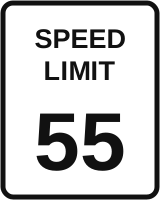
Speed limits are posted in miles per hour (mph) and set by each state. Typical limits are 20–30 mph in residential areas and school zones, 30–45 mph on city streets, and 55–75 mph on highways. A few rural highways in Texas go up to 85 mph. When no limit is posted, the state's default limit applies, so check the handbook.
School buses
When a school bus has its red lights flashing and its stop arm out, traffic in both directions must stop and wait until the lights stop flashing. On a divided highway with a median, many states do not require traffic going the opposite way to stop. Passing a stopped school bus brings heavy fines in every state.
Emergency vehicles and "Move Over" laws
When an ambulance, fire truck or police car approaches with its siren or lights on, pull over to the right edge of the road and stop until it passes. All 50 states have "Move Over" laws: when you pass a stopped emergency vehicle (and in most states, a tow truck or road-work vehicle) on the shoulder, move over a lane if you can, or slow down a lot if you can't.
Alcohol, phones and seat belts
- Drink driving: the legal limit is 0.08% blood alcohol concentration (BAC) in every state except Utah, where it is 0.05%. Drivers under 21 face "zero tolerance" limits, usually 0.02% or lower.
- Phones: almost every state bans texting while driving, and many states ban holding a phone at all while driving.
- Seat belts: required for adults in every state except New Hampshire, which only requires them for drivers and passengers under 18. Children must ride in a car seat or booster seat suited to their age and size.
Getting a licence
Most states use graduated driver licensing: a learner's permit (driving only with a licensed adult), then an intermediate licence with limits on night driving and passengers, then a full licence. Visitors can usually drive with their home licence for a limited time. Carrying an International Driving Permit alongside it is a good idea, and some rental companies require one.
Common road signs
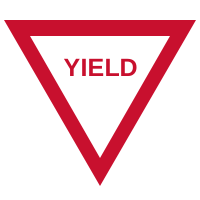
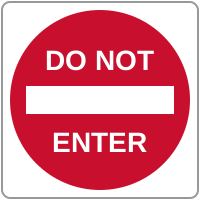
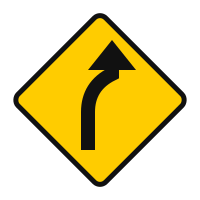
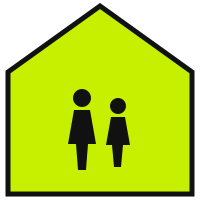
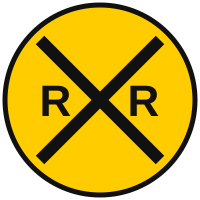
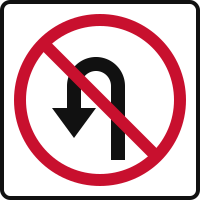
US signs use shape and colour to tell you what kind of message they carry: red for stop or prohibited, yellow for warnings, white for rules, and fluorescent yellow-green for schools and pedestrians.

Practice quiz
Pick an answer to see whether you're right and why.
Official sources
- USA.gov: state motor vehicle services. Find your state's DMV and driver handbook.
- Manual on Uniform Traffic Control Devices (MUTCD). The national standard for road signs and markings.
- NHTSA road safety. Federal guidance on seat belts, impaired and distracted driving.